
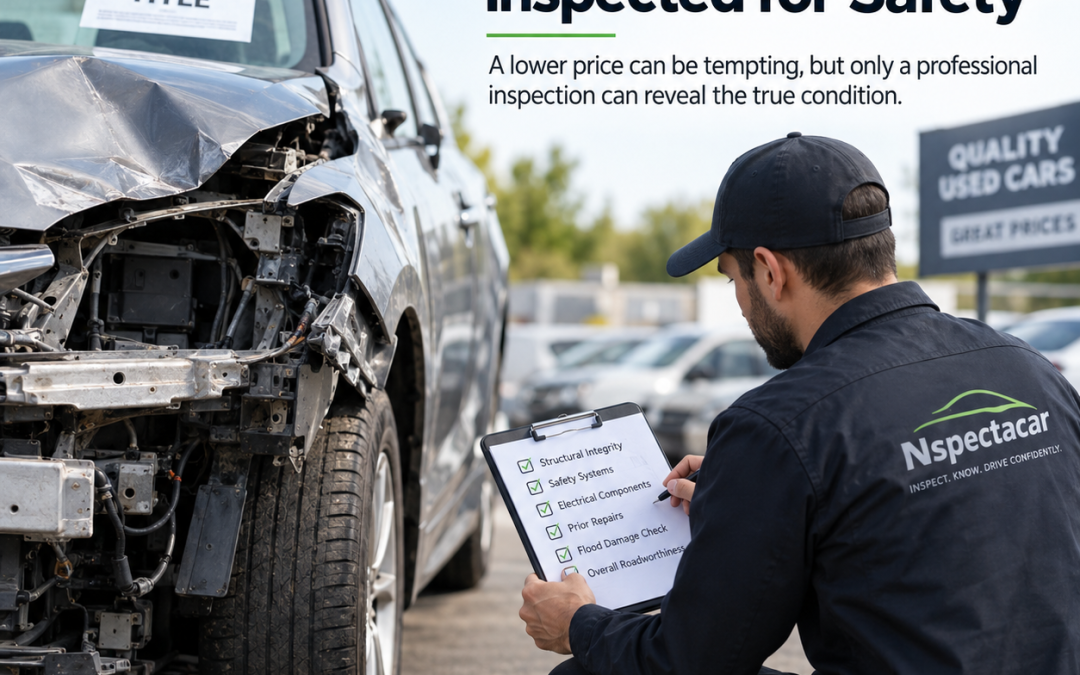
Salvaged vehicles being sold should always undergo strict safety and roadworthiness inspections before returning to the road to protect drivers from hidden structural or mechanical damage.
Thousands of vehicles that were once declared “total loss” return to roads. Dealerships repair, retitle, and resell these salvaged vehicles at lower prices.
Is It Legal to Sell Salvaged Cars?
This is a totally fair and legal practice in many states, but salvaged vehicles must meet road safety standards. Real issues begin when sellers repaint salvaged vehicles to make them look clean but leave the internal, expensive damage unrepaired.
At Nspectacar, we believe every buyer deserves to know exactly what they’re purchasing before they hand over their money. Don’t fall for lower prices, as structural, electrical, and mechanical damage can cost you way more than the actual price of the car.
What does “Salvaged Vehicle” mean?
A vehicle gets a salvage title when an insurance company decides it’s cheaper to total it than to fix it. In other words, the repair costs are too high compared to what the car is actually worth.
A salvage title does not mean a car can never be driven safely. If the repair job is done the right way, salvaged vehicles are a good bargain for budget-conscious buyers. This situation usually happens after:
- Major collisions that damage the structure of the car
- Flood damage where engine and electrical components are damaged
- Fire damage that destroyed electronics, wiring, or plastic parts
- Theft recovery where the car was stripped before recovery
- Severe weather damage
Once a vehicle is declared salvaged, it is legally removed from the road. After repairs, authorities inspect the car, and then these cars return to the road with a salvage title.
Hidden Dangers of Salvaged Cars
On paper, everything looks good about salvaged cars. Buying a salvaged car adds another layer of risk. Dealerships mainly focus on making the vehicle presentable instead of repairing every component.
The lower purchase price is one of the main reasons buyers consider salvage or rebuilt vehicles. The objective should not be to find the cheapest vehicle, but the right car. There are strong possibilities that a salvaged car might have:
- Structural weakness
- Airbag and restraint system issues
- Hidden flood damage
- Compromised electrical systems
- Malfunctioning safety systems
- Poorly calibrated ADAS features
- Substandard replacement parts
- Used parts from damaged vehicles
Many buyers assume that if a rebuilt salvage vehicle passed its state’s mandatory inspection, it must be safe. A vehicle with this title indicates that a car is legally allowed to return to the road.
It is the buyer’s responsibility to ensure that the car is also structurally and mechanically sound. This is where Nspectacar offers the best pre-purchase inspection services in Lynwood, Federal Way, Tacoma, Seattle, and other areas.
Nspectacar Can Help with the Purchase of a Salvaged Car
Don’t let your purchase turn into a costly gamble. The key to making informed decisions is to know the actual condition of any used vehicle. Relying on dealership-provided inspection or assurance is a major mistake most buyers make.
Certified inspectors at Nspectacar professionally inspect and diagnose your desired car on your behalf. We work with buyers only, with no affiliation to any dealership or seller. The complex process ensures that the vehicle is in safe condition, as we:
- Perform a comprehensive structural integrity assessment
- Test the calibration of safety and driver-assistance systems
- Conduct a diagnostic scan for hidden electronic faults
- Evaluate the quality of prior repair work
- Check for signs of flood damage using specialized tools
Recent Comments